
Event photos and UK GDPR: what organisers need to know
Lawful basis, informing attendees, taking photos down, facial recognition: the legal reference points and good practice for photographing a UK event with confidence.
William · event photographer, founder of Pixilive
· 7 min read
A conference without photos no longer exists. Speakers expect them, partners ask for them, and the communications team counts on them from day one. But behind every photo there is a person, and a question that comes up at every event: are we actually allowed to publish it?
Rest assured, it isn’t about getting 800 attendees to sign a release. Here are the broad principles for events in the United Kingdom and a few simple habits that we have been applying on the ground for years.
This article offers reference points, not legal advice. For a specific case, speak to a solicitor or your organisation’s data protection officer. For an event in the European Union, EU GDPR applies, often alongside national rules: France, for example, protects a person’s image far more strictly.
What the law says
The UK has no single “image right”. HMRC’s own guidance puts it plainly: UK law does not recognise such a concept. Protection comes from several sources instead: data protection law, the misuse of private information, advertising rules and the conditions set by the venue.
A photo of a recognisable person is personal data. As soon as someone can be identified, UK GDPR applies to taking, storing and publishing the picture. You therefore need a lawful basis.
Consent is only one lawful basis. For general event coverage, many organisers rely on legitimate interests. That is not a free pass: the ICO asks for a three-part test, done before you start. Is the interest legitimate? Is using the photos necessary for it? Does it override the person’s own interests and rights? Write the answers down.
An opt-out is not consent. Letting people say no is good practice, but it does not turn your lawful basis into consent. If you do rely on consent, it must be a clear, affirmative act, never a pre-ticked box, and people must be able to withdraw it.
Advertising is a separate matter. The CAP Code urges marketers to obtain written permission before featuring a member of the public in marketing communications. Agreeing to appear in an event gallery and finding your face on a billboard for an unrelated product are not the same thing. For an advertising use of a portrait, get it in writing.
Inform, give a choice, take down if needed
In practice, a calm event rests on three actions.
1. Inform, before and during
Before the event, add a clear notice to the registration form or invitation: the event will be photographed and filmed, here is what the images will be used for (event gallery, social media, communications), here is your lawful basis, and here is how to object. If you ask for consent for a particular use, such as promotional campaigns, give it its own unticked box.
On site, put a large sign at the entrance, ideally at badge registration, where everyone passes. It reminds people that photos and videos are being taken and explains how to stay out of them.

2. Let people choose, at a glance
It is the advice we give all our clients: have lanyards in a different colour from the official ones, set aside for people who don’t wish to be photographed. At registration, a tub of these lanyards and a sign explaining the colour code. Everyone chooses, without having to justify themselves.
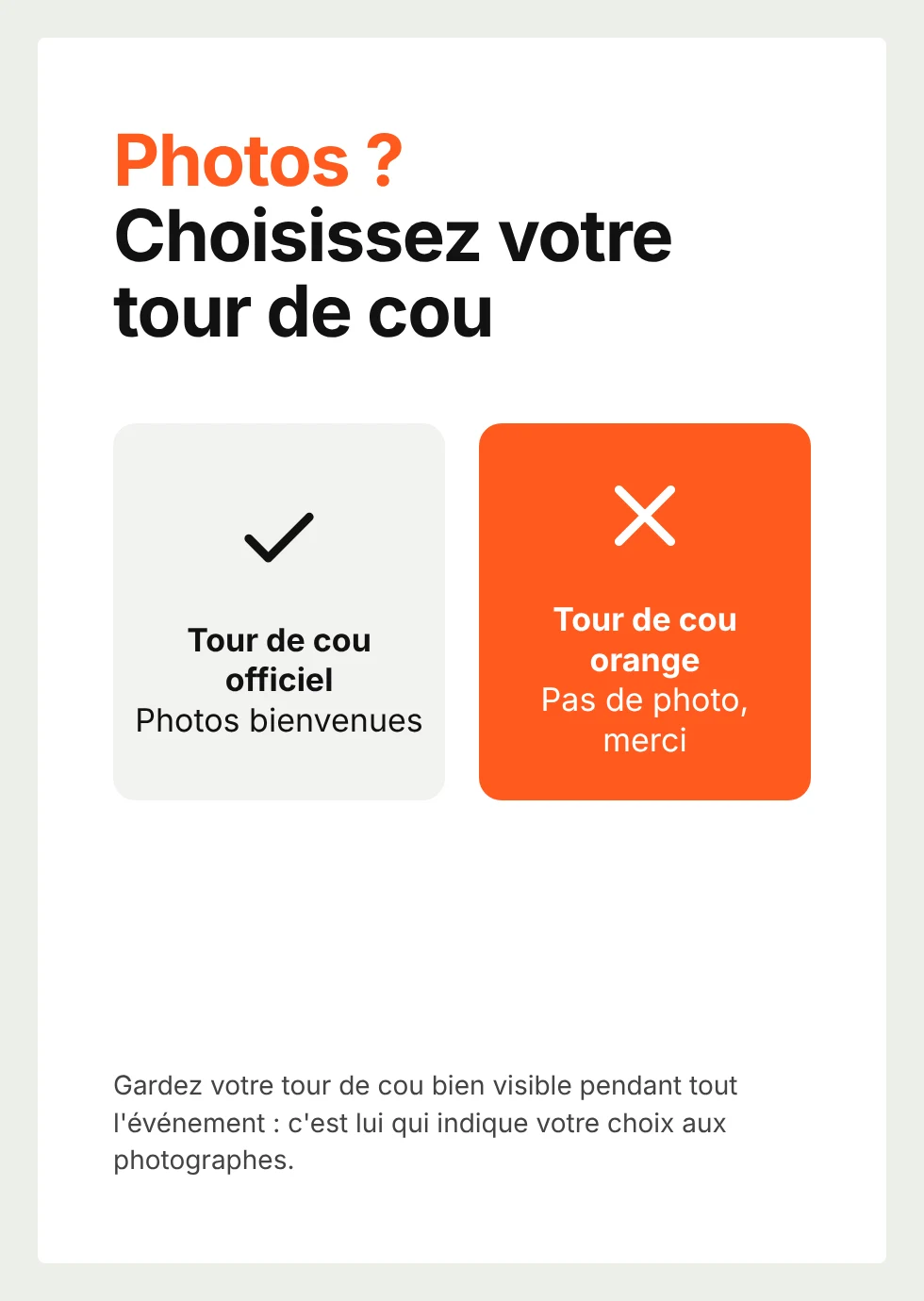
The benefit to the photographer is immediate: they can see at a glance, even in a crowd or at a drinks reception, who would rather stay out of shot. No list to memorise, no faces to remember.
We recommend this system to all our clients, and it was applied particularly well at In The Loop in Berlin: a pink lanyard for “photos welcome”, a white one for “no photos, please”. In a nice touch, the sign stated that the choice made on site overrode the one made at registration. You are entitled to change your mind.
Two rules to make it work:
- A colour clearly distinct from official, staff and exhibitor lanyards. Avoid two shades that look alike under stage lighting.
- Remind attendees that it is up to them to keep the lanyard visible. With a badge flipped over or hidden under a jacket, the photographer has nothing to go on.
3. Take down quickly
Despite every precaution, someone may dislike a photo or appear by mistake: a bad angle, a change of heart, a lanyard nobody noticed. What matters then is how fast the photo comes down.
People can object to the use of their picture or ask for it to be erased, verbally or in writing. You have one calendar month to respond, and the right is not absolute in every case. Since June 2026, organisations must also have a process for handling data protection complaints. For a gallery photo, the simplest answer is usually to remove it, the same day.
In a Pixilive gallery, any visitor can report a photo and ask for it to be removed, straight from the gallery, with no account. The report goes to the organiser, who removes the photo in one click. How it works is described in the reports documentation.
Think about duration too: personal data should be kept no longer than necessary, so set a retention period that fits your purpose. An event gallery is not meant to stay online for ever. At Pixilive, we limit the retention of galleries and photos to 12 months.
What about facial recognition?
Finding your photos by sending a selfie: the idea is appealing, and more and more solutions offer it. Legally, it is no small detail.
Biometric data used to identify someone uniquely is special category data under UK GDPR. Using it takes a lawful basis and a separate condition. According to the ICO, explicit consent is likely to be the most appropriate condition, people who decline must be offered a suitable alternative, and you must not assume that someone walking into view of a recognition system has consented.
Platforms offering facial recognition rely on consent given at sign-up: the attendee creates an account, accepts the terms and sends a selfie. For that person, the question seems settled.
The problem lies elsewhere: with everyone who never creates an account and has accepted nothing. To find one person’s photos, the system has to analyse the faces in the gallery and compute a biometric template for each to compare with the selfie. Attendees who asked for nothing therefore go through that processing too. Even if it is brief and the templates are deleted afterwards, it still happens.
For an organiser, that is a real risk, and processing that is hard to justify and hard to control: how do you make sure the faces of attendees who refused, or simply asked for nothing, are never analysed? A lot of constraints for finding a drinks reception photo.
That is why Pixilive does not use facial recognition. To get everyone their photos, individual spaces work with a QR code: the link between a person and their photos is an identifier, not their face.
The checklist
- A lawful basis chosen and written down, with a legitimate interests assessment if that is your basis.
- A clear notice at registration or on the invitation, with the intended uses.
- A sign at the entrance and at badge registration.
- Lanyards in a distinct colour, in a tub at registration, with a sign explaining the code.
- A reminder to attendees: the lanyard must stay visible.
- A photographer briefed on the colour code.
- Written permission for any advertising use of a portrait.
- A simple way to ask for a photo to be removed, and a quick reply.
- A set retention period for the gallery.
Sources
- Image rights in the UK, HMRC
- What is the legitimate interests basis?, ICO
- Taking photographs: data protection advice for schools, ICO
- Right to object, ICO
- Right to erasure, ICO
- How to deal with data protection complaints, ICO
- How do we process biometric data lawfully?, ICO
- CAP Code, section 6: privacy, ASA